
Published on 6/3/2026
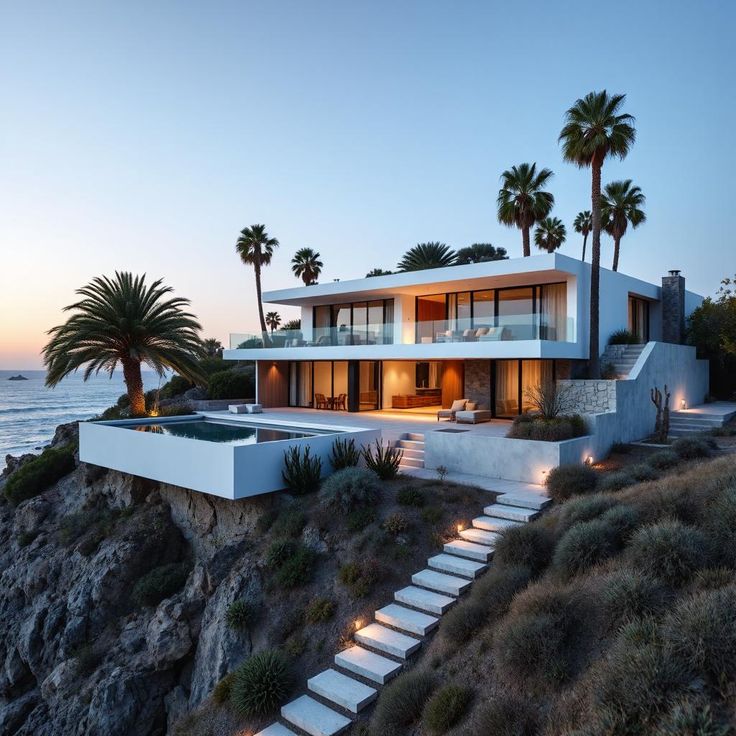
There is a particular kind of home that stops you mid-thought. Not because of its price tag or its famous owner, but because of where it sits and how it dares to sit there. The cliffside mansion occupies a category all its own in architecture and real estate, a property that treats the laws of physics less like rules and more like a starting point for negotiation. At TheHouse48, we think these homes represent one of the most compelling conversations happening in luxury real estate right now.
The Engineering That Makes It Possible
Building on flat ground is already complex. Building on the edge of a cliff is an entirely different discipline. Modern cliffside estates rely on deep-set foundations anchored directly into the rock face, base isolation systems that absorb ground movement, and flexible structural framing designed to bend rather than crack under seismic pressure. Australia's Modscape Cliff House is one of the most discussed examples of this kind of thinking made real. The five-storey modular home is anchored to the cliff face using engineered steel pins, with each residential module stacked downward from a top-floor garage entry. An internal elevator connects the levels. The structure clings to the rock like something grown there, not placed.
What Cantilevering Actually Does to a Space
The most visually dramatic feature of cliffside architecture is the cantilever, where sections of the home extend outward beyond the cliff edge with no visible support underneath. From inside, the effect is startling. The floor meets a wall of glass and then, beyond it, nothing but open air and a view that drops hundreds of feet. This design choice is not purely aesthetic. Cantilevering reduces the structural footprint on the slope, minimising erosion and land disturbance while maximising the usable interior. Floor-to-ceiling glass walls are almost always part of this equation, pulling the landscape inside and dissolving the boundary between the home and its setting.
Location as the Central Design Brief

Some of the most extraordinary cliffside homes treat the terrain itself as the primary material. A home designed by Domenack Arquitectos in Pucusana, Peru occupies one of the highest points of a coastal cliff in the Lima Province, with the master bedroom positioned at the very top and the structure descending the slope in levels, each one offering a different relationship with the ocean below. In South Africa's Garden Route, the SAOTA-designed Cove 3 estate in Pezula was built to integrate so seamlessly with its clifftop surroundings that even the colour palette was chosen to maintain visual continuity with the landscape. These are not homes dropped onto dramatic sites. They are homes shaped by them.
The Value Conversation Around Extreme Locations
Cliffside properties sit in a rare pocket of the market where the land itself commands as much attention as the structure. Privacy is exceptional, views are unobstructed and the sheer exclusivity of the build makes these homes genuinely difficult to replicate. But they also require buyers who understand that the value is as much about experience as it is about square footage. The engineering costs are significant, the maintenance demands are specific and the resale market is niche.
TheHouse48 works with buyers who ask those deeper questions about what a property actually delivers day to day, not just what it looks like in a photograph. A cliffside mansion answers that question loudly and memorably, which is precisely why it continues to redefine what luxury living can mean.
Sign up for our emails and be the first to know about special offers.
Sign In
Comments