
Published on 10/28/2026
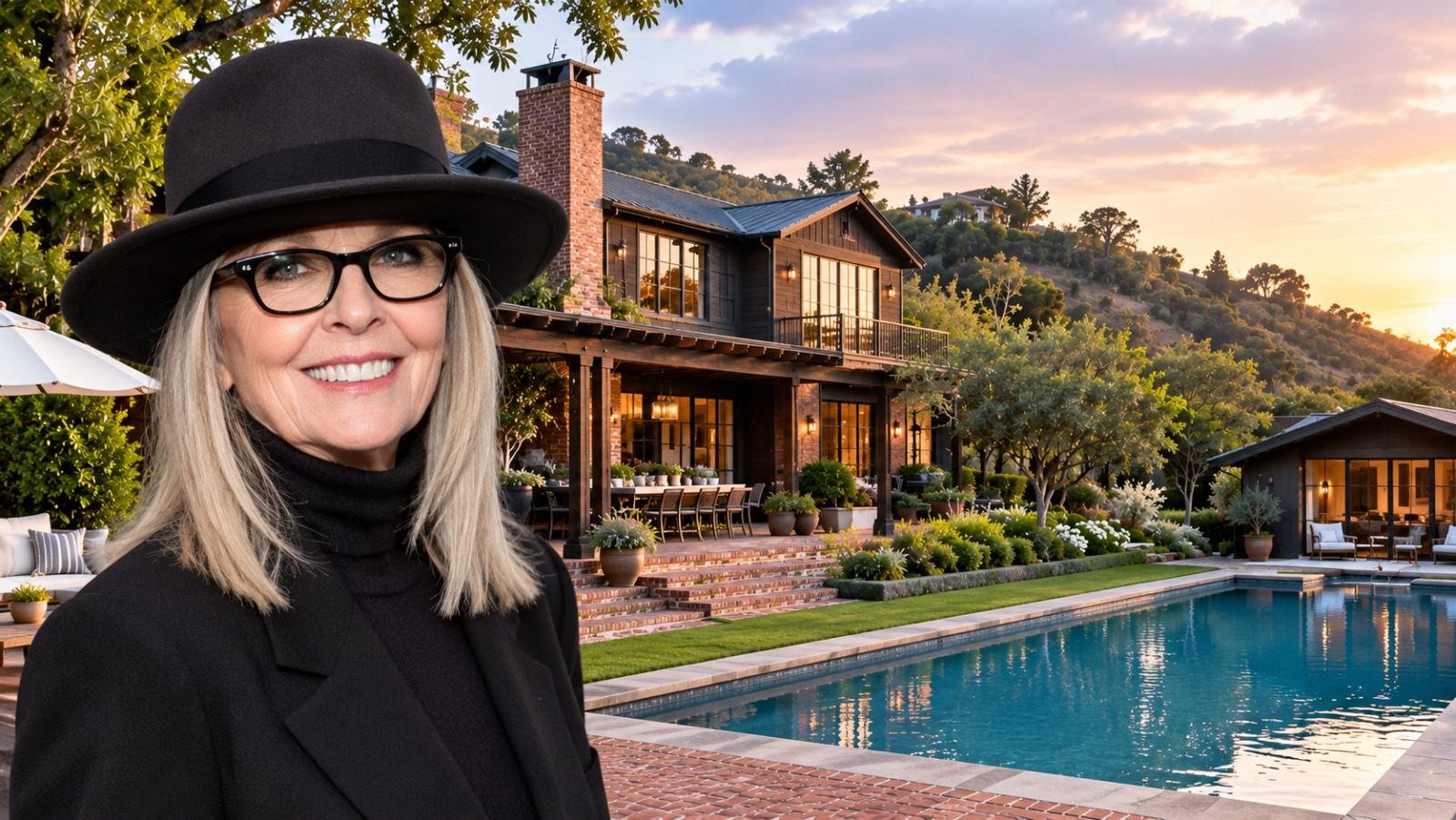
Diane Keaton died on October 11, 2025, at the age of 79. She left behind one of the most extensively documented relationships between a person and their homes in Hollywood history, a decades-long practice of buying, completely reimagining and eventually selling properties that earned her a reputation as seriously as her acting career. The Sullivan Canyon estate she called The House That Pinterest Built entered escrow in August 2026, nine months after her death, ultimately selling for $18 million against an original asking price of $28.9 million. The gap between those two numbers is the most instructive part of this story. At TheHouse48, the Diane Keaton estate sale is less a celebrity transaction than a precise case study in what happens when a property is designed entirely around one person's vision and then has to find an audience that does not share that vision at the price it deserves.
The Property She Built From a $4.7 Million Canvas
Keaton purchased the Sullivan Canyon property in 2011 for $4.7 million. What followed was a renovation that lasted years and produced something that defies standard property categorisation. The estate was inspired by her childhood love of The Three Little Pigs, and that influence is literally embedded in its structure: 75,000 hand-selected 18th-century bricks sourced from Chicago form the property's foundation. The kitchen, which she described as the heartbeat of the house, features a custom-built island, chicken-wire cabinetry and pendant lights repurposed from a former chicken coop. The 9,219 square foot estate has five bedrooms, eight bathrooms, a separate guest house and a double-gated motor court with mature landscaping providing complete street privacy. She documented the entire renovation process in her 2017 book, also titled The House That Pinterest Built, which made the property one of the most publicly narrated renovation projects in residential real estate history.
The Pricing Journey That Reveals the Market's Verdict
Keaton listed the property in March 2025, five months before her death, at $28.9 million. The listing was reduced to $27.5 million within months. After her death in October 2025, it was relisted at $26.9 million in December. By June 2026 the asking price had been reduced again to $22.9 million, which is the figure that generated the buyer who took it into escrow. The final closed sale price, confirmed by Realtor.com, was $18 million. The total journey from $28.9 million to $18 million represents a reduction of $10.9 million, or 37.7% of the original asking price. The property is now held in trust under Keaton's real name, Diane Hall, with her adopted children, daughter Dexter and son Duke, managing the estate sale as primary beneficiaries.
The Highly Personal Design Problem That Every Distinctive Property Faces
The specific challenge this property presented to the market is one that recurs with exceptional properties created by people of distinctive taste. As the listing notes, Keaton possessed one of the great design eyes of our generation, with an almost oracle-like ability to see potential where others saw limitations. That ability produced a property that is aesthetically coherent, deeply intentional and virtually impossible for a buyer to replicate at any price. It is also, by definition, a property that reflects the taste of one specific person rather than the broad preferences of the buyer market. The rustic-industrial aesthetic, the repurposed agricultural details, the three-dimensional narrative running through every room, all of this creates a property that a certain buyer will find extraordinary and that many other buyers at the $25 million price point will find too specific to embrace. The tax position created a practical argument for selling quickly: the value of a property resets to its market value on the date of the owner's death, meaning the estate's heirs could minimise capital gains taxes by selling relatively soon after probate, which aligned with the estate management timeline.
The Distinction Between Personal Vision and Market Value
This transaction is the clearest recent illustration of a principle that applies at every price point, which we examined in our earlier discussion of how to add value before selling: the improvements that make a property more personally meaningful to its creator are not always the improvements that the resale market will price most generously. A property built around 75,000 hand-selected antique bricks, a chicken coop aesthetic in the kitchen and a narrative inspired by a children's story is worth exactly what one buyer is willing to pay for it, and finding that buyer takes time. The $18 million achieved is not a failure. On a $4.7 million acquisition cost in 2011, it represents a substantial nominal return over fourteen years of ownership. The question the journey asks is whether the $10.9 million reduction from the opening ask represents the correct initial pricing or the correct market outcome. The answer, most likely, is that both questions have the same answer: the opening ask was set at the level the family hoped the property would achieve, and the $18 million is what a buyer decided it was worth without the irreplaceable presence of the person who built it.
TheHouse48 believes that the Diane Keaton estate sale is a genuinely instructive transaction for any seller whose property carries deep personal vision that a buyer will need to adopt rather than inherit. The more distinctive the design, the more patient the sale and the more realistic the pricing needs to be about how large the pool of buyers who share that vision actually is.
Sign up for our emails and be the first to know about special offers.
Sign In
Comments